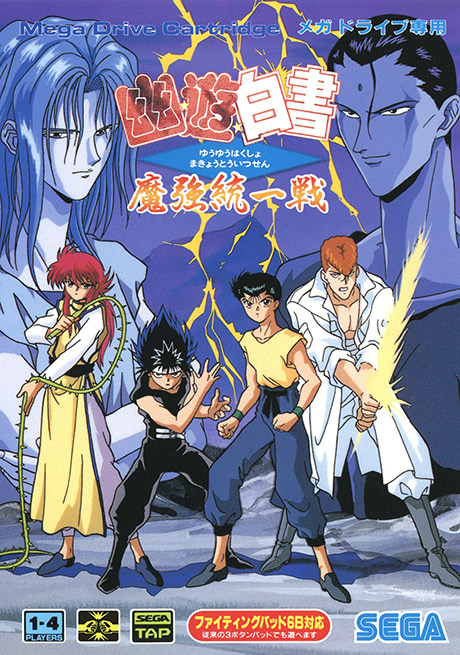
幽遊白書 魔強統一戰
《幽遊白書 魔強統一戰》是以冨樫義博知名漫畫《幽遊白書》為基礎,並由以高速動作遊戲聞名的Treasure開發、1994年在Mega Drive平台推出的對戰格鬥遊戲。雖然發售時Mega Drive在日本的市占率遠不如SFC,但遊戲憑藉極高的完成度、創新的戰鬥系統,以及完全不敷衍的角色動作與打擊感,在玩家之間建立經典地位,被視為多人生亂鬥類型格鬥遊戲的開創者之一。之後Treasure自家的《Guardian Heroes》、以及後續DS平台的《BLEACH》系列,多人混戰的核心概念都可以看見本作的影子。
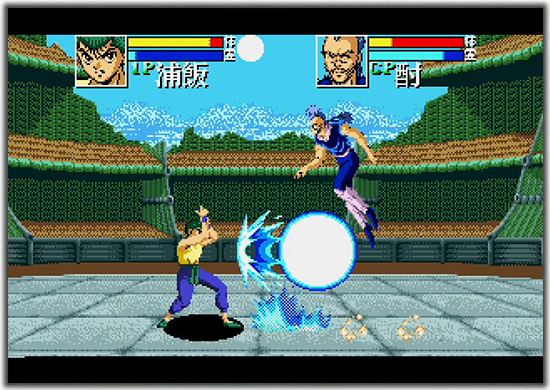
故事背景承接《幽遊白書》的世界觀,可以操作浦飯幽助、桑原和真、藏馬、飛影等人氣角色,在魔界、暗黑武術會等場景中展開混戰。雖然並沒有完整重述原作劇情,而是以格鬥作為主體,但角色的必殺技、招式特徵與人氣場面皆忠實呈現,像幽助的霊丸、飛影的黑龍波、桑原的霊劍等都在遊戲中以誇張又爽快的演出登場。
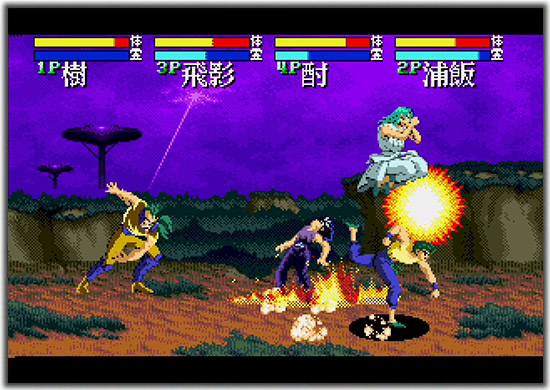
最具特色的設計,是當時極為罕見的「四人大亂鬥格鬥」模式。透過Sega Tap,多達四名玩家能同時進入戰場,在兩條可自由移動的「前後線」之間切換。由於可以被多方包夾,因此取消傳統格鬥遊戲的左右防禦,而改成以「專用防禦鍵」進行上下判定,即使在多人圍攻下仍有生存空間,也讓遊戲更偏向節奏快速、反應即時的近戰混亂體驗。角色攻擊不只會擊中對手,被揍飛的敵人甚至帶有判定,可以直接撞到其他角色形成連鎖打擊,呈現混戰遊戲少見的爽快混沌感。
在操作上刻意簡化許多格鬥遊戲的複雜度,使其對一般玩家更為友善。所有角色的操控皆以「弱攻擊、強攻擊、防禦」三鍵為主,必殺技的指令也非常簡單,沒有昇龍拳或半回圈那種容易輸入錯誤的操作。大部分招式只需「下→」、「下下」、「下上」等少量方向與單鍵按壓即可施放,也降低新手進入門檻。雖然系統簡單,但遊戲卻加入極其先進的機制,包括兩段跳躍、空中連段、空中投技、空中衝刺、地面連段接空中、空中落地再接地面技等「現代空戰格鬥」才會出現的系統,讓本作在1994年的格鬥遊戲之中顯得極為超前。
霊力ゲージ是遊戲節奏的核心。使用必殺技會消耗霊力,而霊力能透過蓄力、攻擊命中、打出連段等方式回復,使角色必須在火力輸出與資源保存之間取得平衡。能像《龍虎之拳》一樣使用挑釁降低對手的霊力,讓倒地後的攻防不再只是單純的「等起身」,而變成「回氣、削對手氣、設攻勢、抓距離」之間的策略選擇。某些飛行道具還能長按蓄力,使其威力、判定與相殺等級提升,甚至能蓄滿後瞬間發射大型霊丸,形成壓制或逼迫對手移動的戰術。
玩家的攻擊技、飛行道具甚至蓄力彈都能彼此抵消,當飛行道具互撞時,威力更高的投射會保留下來繼續前進,呈現出視覺上單純但策略深刻的對抗關係。角色之間甚至能以攻擊撞掉對方的對空技,營造既混亂又公平的混戰環境。
投技設計也相當有趣,採用「擊飛式投技」,投出後的角色會高速飛出,並在碰撞其他角色時繼續造成傷害,使投技不再是單人攻擊,而變成適合四人亂鬥的「範圍型武器」。某些角色能在空中抓取被打飛的敵人,形成投技接空中投技的華麗畫面。
Treasure在製作時基於「混戰節奏優先」的理念,讓角色的許多動作都能藉由取消(Cancel)轉接更高階的必殺技,甚至是超霊撃技。不同角色的超必殺技在特定段落也能被取消,形成「超必殺→必殺→空中→落地→再接連段」這樣極具演出的爽快打擊流程,對當年格鬥遊戲市場來說,是非常大膽也非常創新的設計。
雖然Mega Drive的市場規模劣勢,使得本作當年沒有像SFC上的同類遊戲一樣擁有龐大玩家群,但品質上的壓倒性表現,讓它在格鬥遊戲玩家以及《幽遊白書》粉絲之間口碑極好。許多人認為它比當時SFC版《幽遊白書2 格鬥之章》更具深度與娛樂性。甚至在多年後,這款遊戲仍在日本與巴西等地被視為MD平台的代表作之一。1999年透過巴西Tectoy以《Yu Yu Hakusho: Sunset Fighters》名義發售,也成為少數跨出日本市場的MD格鬥名作之一。2019 年Mega Drive Mini日版收錄本作,讓更多現代玩家有機會接觸這款早期的多人成亂鬥經典。
整體而言,《幽遊白書 魔強統一戰》之所以能成為傳奇,不僅因為它基於熱門 IP,更因為Treasure以格鬥遊戲之名實際嘗試的是「四人混戰的極限表現」。從簡化而爽快的操作、極為先進的空中系統、多層次的相殺與霊力運用,到角色被打飛後像炮彈般轟出場外的誇張效果,展現90年代遊戲開發團隊的創意巔峰,也提前揭示未來多人格鬥遊戲的方向。
Yu Yu Hakusho: Makyo Toitsusen is a 1994 Mega Drive fighting game developed by Treasure, a studio renowned for its fast-paced, highly technical action titles such as Gunstar Heroes. Based on Yoshihiro Togashi’s hit manga and the massively popular TV anime, the game delivers a frenetic combat experience that was remarkably ahead of its time. Despite releasing on the Mega Drive—a console with smaller market share in Japan compared with the Super Famicom—the game’s meticulous polish and ambitious design showcased Treasure’s philosophy of never compromising on quality, even when working on less dominant hardware.
What makes the game especially unique is its chaotic multi-character combat. At a time when one-on-one fighters dominated the arcades, Makyo Toitsusen allowed up to four players to battle simultaneously using the Sega Tap, creating a free-for-all experience rarely seen in the genre. This foundation of multi-fighter mechanics later influenced Treasure’s own Guardian Heroes and even modern multi-fighter handheld titles such as Bleach DS, making it one of the earliest pioneers of the multi-character fighting system.
The combat system incorporates an impressive range of mechanics for its era. The game uses a two-line battlefield that players can switch between freely, though movement to unoccupied lines becomes slower to prevent easy escapes. Guarding relies on a dedicated guard button, eliminating directional guarding altogether—an unusual system that ensures players can withstand attacks from both sides even in chaotic four-way battles. Attacks from all directions become manageable, and blocking remains reliable thanks to a rule preventing chip damage from finishing a player, creating constant opportunities for comebacks.
Controls remain simple due to compatibility with the Mega Drive’s three-button pad. Players have just guard, light attack, and heavy attack, with special moves executed through extremely simple commands such as quarter-circle, double-tap, or repeated button presses. There are no complex motions like dragon punches or “yoga flame” rotations, allowing characters to be learned quickly and executed precisely even during hectic multi-fighter clashes. This simplicity ensures players can focus entirely on spacing, movement, and reading opponents rather than fighting the controls.
Throws function as powerful launchers. Once a character initiates a throw-type attack, it can knock multiple opponents into the air simultaneously, and certain fighters can chain air throws or extend combos afterward. Some skills send enemies flying toward walls, allowing them to collide with other fighters and create dynamic, chain-reaction damage. The game also includes an advanced clash system: opposing attacks can cancel each other out based on priority rankings, meaning powerful charged projectiles can erase weaker attacks, while physical strikes can intercept incoming moves if timed properly.
Movement options far surpassed most fighting games of 1994. Characters can dash by double-tapping, cancel into further dashes, and even run depending on the fighter. There are also backsteps with brief invincibility, double jumps, short hops, aerial movement, and full airborne combos. Modern staples like launching the opponent, pursuing them in the air, and finishing with an aerial throw all appeared in this game years before they became genre standards. Some characters can even transition from air combos back into ground strings, creating surprisingly advanced combo routes for its time.
Special attacks rely on a spirit-energy gauge similar to the system seen in Art of Fighting. Energy regenerates by charging or by landing combos, allowing skillful play to sustain itself. Taunts are not mere animations—they actively drain the opponent’s energy, adding tactical layers to knockdowns. Certain projectiles can also be charged to increase damage, priority, and size, enabling massive shots like Yusuke’s fully charged Spirit Gun to dominate the screen. Charged attacks can be canceled with guard and fired later, allowing players to store powerful options for key moments.
Cancel mechanics are extensively integrated, enabling players to chain normal moves into special attacks, and even cancel portions of super moves depending on the character. This creates combo-heavy, momentum-driven gameplay that anticipated the direction of future fighting games. Released during the era of Super Street Fighter II X and The King of Fighters ‘94, Makyo Toitsusen stood out as one of the most innovative titles of its generation. Many ideas it introduced—aggressive mobility, air combat, strong defensive options, combo-centric mechanics—would later become standard parts of the genre.
The cast includes beloved characters from the manga and anime: Yusuke with his Spirit Gun and shotgun punches, Kuwabara and his Spirit Sword techniques, Kurama’s rose whip and demon-fox transformation, Hiei’s iconic Dragon of the Darkness Flame, Genkai’s spiritual strikes, Chu’s drunken fighting style, Jin’s wind-based aerial mobility, Toguro brothers’ monstrous strength, Itsuki’s dimensional techniques, and Sensui’s devastating energy attacks. Each character’s moveset faithfully reflects their abilities from the series, while still aligning with the game’s fast and accessible combat system.
Although the game never released in North America or Europe, it gained a cult following in Japan and later in Brazil under the title Yu Yu Hakusho: Sunset Fighters through Tectoy’s 1999 release. Its enduring reputation eventually led to its inclusion in the Japanese version of the Mega Drive Mini in 2019. Over time, the game has been reevaluated as one of the most ambitious and technically impressive fighting games on the Mega Drive, and even as one of Treasure’s finest works. Many retro enthusiasts consider it one of the best anime-based fighting games ever created, largely thanks to its fluid gameplay, groundbreaking mechanics, and surprising depth.
運費計算方式:
貨款滿1000元運費外加90元
貨款1000以下:買1件運費外加 60元,買2件運費外加 70元,
買3件運費外加 80元 ,買4件運費外加 90元
貨到付款外加30元手續費
外島及大陸地區運費另計
付款方式:
線上刷卡:本站採用Paypal線上刷卡
虛擬帳號匯款:屬於您專屬的虛擬帳戶,方便站長查帳使用,本站強力推薦
實體ATM匯款:請將匯款帳號記錄下來至各大銀行ATM提款機轉帳
超商條碼繳費:請列印本站提供的條碼至四大超商繳費
線上轉帳:透過玉山銀行線上ATM轉帳(此系統只支援IE瀏覽器)
貨到付款:本站採用黑貓宅急便貨到付款
其他注意事項:
如需購買線上點數卡請直接跟站長連絡,本站不提供點數卡的線上付款
-
幽遊白書 魔強統一戰
- 定 價:
- 售 價: 0.00
- 庫存量: 0 套
- 已賣出: 0 套
 人氣指數: 0.3 / 6 顆星
 -
魔法門之英雄無敵:上古紀元
- 定 價:
- 售 價: 0.00
- 庫存量: 0 套
- 已賣出: 0 套
人氣指數: 0.4 / 6 顆星