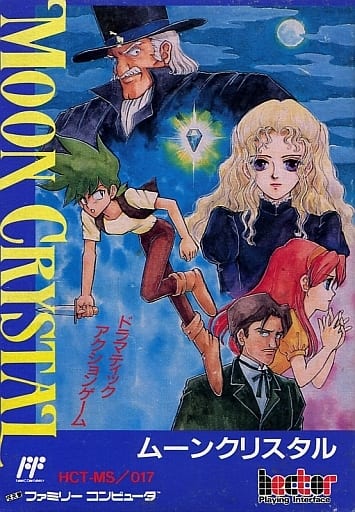
月水晶 / 月光寶石
由 Hector於 1992 年 8 月 28 日在 Famicom 上推出的《月水晶》(Moon Crystal / ムーンクリスタル),是一款誕生於主機世代交替之際、卻憑藉技術與美學達到驚人高度的動作遊戲。它常被核心玩家譽為紅白機末期最被低估的「隱藏神作」,原因不僅在於稀有,更在於它在 8 位元硬體上實現了乎電影化的流暢演出。
最令人震撼之處,在於其高度接近「Cinematic Platformer」風格的動作呈現。與 Prince of Persia 相似,強調角色動作的連貫性與真實感,而非單純的反應速度。主角的每一個動作,從起跳、翻滾到攀爬,都擁有豐富的中間動畫幀,使整體操作呈現出絲滑流暢的視覺效果。在紅白機有限的性能下,這種細膩程度幾乎達到技術極限,甚至讓人產生「這不像 8 位元遊戲」的錯覺。
在視覺與敘事表現上,同樣展現出罕見的野心。關卡之間穿插大量全畫面劇情演出,角色頭像會隨對話變化表情,甚至出現眨眼與嘴型動作,使故事呈現更接近動畫分鏡。整體色調採用明亮柔和的配色,搭配清脆而帶有奇幻氛圍的音樂,成功營造出濃厚的 90 年代初日本動畫風格,讓玩家在操作之外,也沉浸於一段帶有童話色彩的冒險旅程之中。
故事背景設定於神秘的西爾菲斯島,圍繞著擁有強大力量的「月水晶」展開。一名瘋狂科學家為了利用這股力量製造武器,綁架主角 Ricky 的家人,企圖逼迫其父親合作。劇情由此展開,Ricky 為了拯救家人,帶著傳家之物踏上危機四伏的旅程。他將穿越機關密布的設施與敵人重重的據點,最終潛入漂浮於空中的要塞,直面科學家,奪回月水晶,守護世界的平衡。這樣的敘事雖然遵循經典王道冒險結構,但透過細膩演出,使其更具情感張力。
在操作設計上,強調對角色動作與地形判斷的精準掌控。Ricky 具備靈活的二段跳能力,可以細微調整跳躍軌跡,以應對複雜的陷阱與高低落差。同時,引入當時相當先進的「抓邊與翻越」系統,可以懸掛在平台邊緣並向上攀爬,這大幅提升關卡的垂直設計與策略深度。戰鬥方面則以短刀為主,攻擊距離雖短,但透過翻滾與走位,可以形成流暢而富節奏感的近戰對抗。隨著進度推進,玩家還能透過道具強化攻擊性能,使原本艱難的戰鬥逐漸變得更具掌控感。
然而,這部作品的市場命運卻顯得格外坎坷。1992 年正值 Super Famicom 與 Mega Drive 主導市場的時期,玩家與媒體的目光早已轉向 16 位元世代。《月水晶》作為一款純紅白機作品,在當時幾乎被忽視,銷量表現不佳。正因如此,其卡帶發行量極少,反而在後世成為收藏市場中的稀有珍品,被視為紅白機時代的「天價卡帶」之一。
隨著時間推移,這款遊戲的評價逐漸被重新發現。許多評論者認為,它不僅是紅白機動作遊戲的集大成,更是一個象徵——象徵著開發者在硬體極限下所能達到的創意與執行力。它用實際成果證明,即使在即將退場的平台上,依然可以誕生超越世代想像的作品。
對許多曾經接觸過本作的玩家而言,那段記憶往往停留在某個畫面:在月光灑落的背景之中,Ricky 緊貼懸崖邊緣,順勢翻身而上,隨即以優雅的二段跳躲過敵人攻擊。那種帶著節奏感與重量感的動作,不只是操作技巧的體現,更像是一段被玩家親手演出的動畫場景,也正是《月水晶》歷久彌新的魅力所在。
Released by Hector on August 28, 1992, for the Famicom, Moon Crystal (ムーンクリスタル) stands as one of the most remarkable late-era titles on the system. Emerging at a time when the industry had already shifted its attention toward 16-bit hardware, this game quietly pushed the aging 8-bit console to its absolute limits, earning a reputation among enthusiasts as a hidden masterpiece.
What truly sets Moon Crystal apart is its cinematic approach to action. Much like Prince of Persia, the game emphasizes fluid, realistic animation over raw speed. The protagonist, Ricky, moves with an extraordinary level of detail—each jump, roll, and climb is composed of numerous animation frames, creating a smoothness rarely seen on the Famicom. The result is a gameplay experience that feels far more advanced than what one would expect from 8-bit hardware, often drawing comparisons to early 16-bit titles.
Visually and narratively, the game demonstrates an equally ambitious design philosophy. Between stages, players are treated to full-screen story sequences featuring expressive character portraits that blink and move their mouths during dialogue, evoking the feel of an animated film. The overall presentation is enhanced by a soft, luminous color palette and a bright, melodic soundtrack that captures the essence of early 1990s Japanese fantasy storytelling. This combination gives the game a dreamlike atmosphere that lingers long after play.
The story itself follows a classic heroic structure set on the mysterious island of Sylphis. A powerful artifact known as the Moon Crystal becomes the target of a deranged scientist who seeks to harness its energy for weapon development. In pursuit of this goal, he kidnaps Ricky’s family in an attempt to coerce his father into cooperation. Driven by determination, Ricky sets out on a perilous journey through trap-filled environments and enemy strongholds, ultimately aiming to infiltrate a floating fortress, defeat the scientist, and reclaim the crystal. While the narrative adheres to familiar adventure tropes, its cinematic presentation gives it a stronger emotional impact.
Gameplay in Moon Crystal revolves around precision and control. Ricky’s ability to perform a highly responsive double jump allows players to finely adjust movement mid-air, which is crucial when navigating the game’s many hazards. One of its most forward-thinking mechanics is the ability to grab onto ledges and pull himself up—an advanced feature for its time that adds vertical complexity to level design. Combat is handled with a short-range dagger, encouraging players to rely on timing, positioning, and evasive maneuvers such as rolling. As the game progresses, power-ups enhance attack range and strength, gradually shifting the balance in the player’s favor.
Despite its technical and artistic achievements, Moon Crystal suffered from unfortunate timing. By 1992, the gaming world had largely transitioned to systems like the Super Famicom and Sega’s Mega Drive, leaving late Famicom releases overlooked. As a result, the game saw limited commercial success and a relatively small production run. Ironically, this scarcity later elevated its status among collectors, making original cartridges highly sought after and extremely valuable.
Over time, Moon Crystal has gained recognition as one of the finest examples of what the Famicom could achieve at the end of its lifecycle. Critics and retro gaming enthusiasts often cite it as a testament to the ingenuity of developers working within strict hardware limitations. It represents not just a technical accomplishment, but also a creative statement—proof that even a platform nearing obsolescence could still deliver something extraordinary.
For those who experienced it, one image tends to remain vivid: Ricky scaling a cliff under a softly glowing moon, seamlessly transitioning into a graceful double jump to evade an enemy. It is in moments like these that Moon Crystal transcends being merely a game, becoming instead a kind of interactive animation—an enduring memory shaped by motion, timing, and atmosphere.
運費計算方式:
貨款滿1000元運費外加90元
貨款1000以下:買1件運費外加 60元,買2件運費外加 70元,
買3件運費外加 80元 ,買4件運費外加 90元
貨到付款外加30元手續費
外島及大陸地區運費另計
付款方式:
線上刷卡:本站採用Paypal線上刷卡
虛擬帳號匯款:屬於您專屬的虛擬帳戶,方便站長查帳使用,本站強力推薦
實體ATM匯款:請將匯款帳號記錄下來至各大銀行ATM提款機轉帳
超商條碼繳費:請列印本站提供的條碼至四大超商繳費
線上轉帳:透過玉山銀行線上ATM轉帳(此系統只支援IE瀏覽器)
貨到付款:本站採用黑貓宅急便貨到付款
其他注意事項:
如需購買線上點數卡請直接跟站長連絡,本站不提供點數卡的線上付款
-
月水晶 / 月光寶石
- 定 價:
- 售 價: 0.00
- 庫存量: 0 套
- 已賣出: 0 套
 人氣指數: 0.6 / 6 顆星